
why “form and flow?”
We chose the name With Form and Flow to describe fluidity through structure.
We all work in and through human infrastructure, which includes the body, language, institutions, social rules, and cultural expectations.
How can a practice that centres fluidity through form support us in showing up authentically in classrooms, board rooms, family rooms, and beyond?
How can structures such as rituals support us in being accessible to our innate wisdom?
We represent this work with the beauty of the fern’s spiral, a geometric form that unfurls with fluidity.
Self-Facilitation and innate wisdom
A self-facilitation practice invites us into deep listening and responsiveness: in bringing our awareness to our mental, emotional, and physical states while engaging with others, we create space for our innate wisdom to guide us in these moments.
There is magic in the connection between ritual and self-facilitation. The importance of cultivating and maintaining connection with ourselves as we step into work with others - whatever that work may be - is an ongoing, dynamic practice that defies perfection.
We all experience drift at times; it is human nature to be pulled into thoughts and feelings that are outside of ourselves. A self-facilitation practice amplifies our ability to notice when we are drifting and to create ritual and in-the-moment practices that help us come back to ourselves.
Whether it be project design, research, facilitation, leadership, or creative pursuits, WF+F offers a supportive process to help you lean into stuck-points, invite curiosity, and open possibilities for what comes next all while taking care of yourself in the process. This support is available for anyone. You might be an academic researcher, community-based researcher, creator, change-maker, project designer, program facilitator, executive, writer, artist, parent, teacher, and/or a student. This space is for our emerging community of people seeking to show up as themselves.
Our offerings:
Free monthly newsletter
Free mini-zine with a 2-minute centring ritual
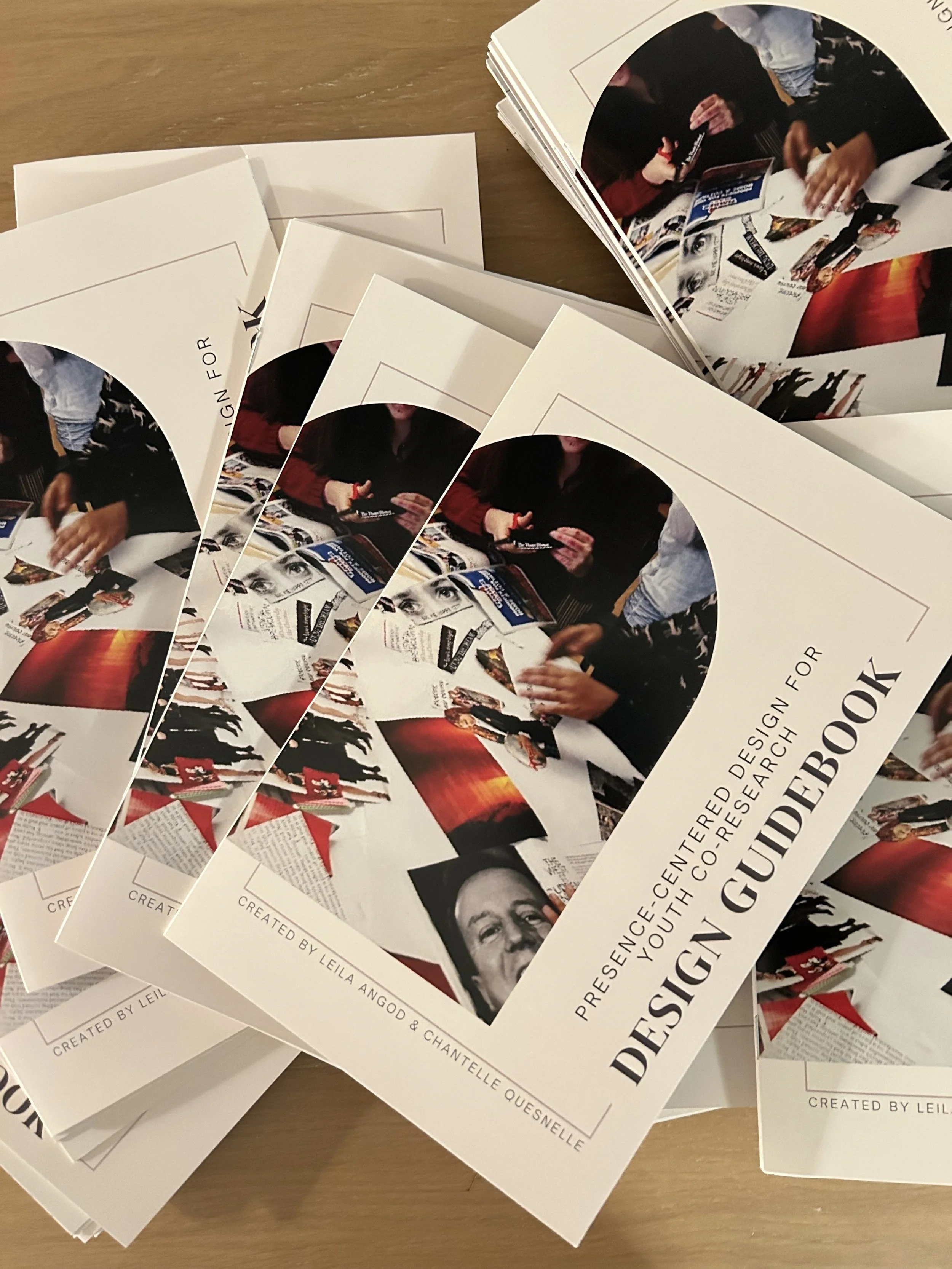
Free guidebook for designing community-engaged research with young people
Invite us to design and facilitate a presentation or workshop for your team - pitch us on your idea! (presentation and workshop menu coming soon)
Invite us to consult on developing, sustaining and/or working through stuck-points in your research project, program, curriculum, professional development, etc.



Explore some of our Past Projects
School Board-University Partnership, Spring 2025
This study, funded by the Social Sciences and Humanities Research Council of Canada and conducted in collaboration with a school board, engaged feelings of belonging as an entry point into the systemic inequities faced by Black students. The goals of this short-term initiative were to (1) build an understanding of Black students’ experiences of belonging and (2) through the process of building this understanding, to contribute to students’ positive feelings of belonging. To achieve these goals, this project had three specific objectives: (1) to develop and implement a youth participatory action research (yPAR) project for Black students to analyze Board climate survey data on belonging; (2) to synthesize students’ analysis into a digital zine (a self-publication, pronounced ZEEN, short for magazine), and include tips on how school boards can conduct youth co-research to contribute to equitable outcomes for Black students; (3) to share the digital zine within and beyond the school board to initiate conversations and identify ways to improve student belonging. The zine combined text and visual elements to add another dimension to the quantitative school board data, providing narratives of Black students’ experiences, and stating their calls to action for systemic change. The zine zine was the foundation for a report to board leadership and a student presentation to staff members.
Mini-skills Workshop, February 2025
National Association of School Psychologists, Annual Conference, Seattle, WA
Our workshop priorities were for participants to:
Be excited and informed about youth co-research
Apply our presence-centered approach to envision a youth co-research project
Have tools and a plan to begin this project
The open-access guidebook is published here.
Professional Development for Provincial School Board Leadership Teams
This session provided an overview of youth participatory action research and a template for participants to design their own project. Our process invited participants to be led by their feelings in what they were creating, and to apply discernment in considering structural constraints and possibilities. We facilitated a discussion on challenges that participants encountered in the process that tapped into the collective knowledge in the room while providing guidance.